Health and Safety Policy — House Clearance Bayswater
House Clearance Bayswater is committed to maintaining a safe working environment for all staff, contractors and the public during every property clearance and rubbish removal operation. This policy sets out the standards and procedures that govern health and safety across our clearance and waste removal services, ensuring legal compliance, risk management and a culture of continuous improvement.Purpose and scope
This document applies to all clearance activities, including house clearance, rubbish removal, bulky waste collection and property clearance tasks. It covers planning, site work, vehicle operations, segregation of waste and the safe handling of items encountered during clearances. The policy supports safe systems of work for residential and commercial clearances across our service area without relying on local specifics or procedural guides.
Policy statement
We will manage health and safety risks by conducting robust assessments, assigning responsibilities, providing training and ensuring appropriate equipment. Our objective is to reduce accidents, control exposure to hazardous materials and ensure that all site activities are carried out in a manner that protects people, property and the environment.Responsibilities
The following responsibilities apply to everyone involved in clearance operations: management will ensure resources and oversight; supervisors will enforce safe working methods; operatives will follow procedures and report hazards. Contractors and subcontractors engaged for waste removal must comply with this policy and demonstrate competency.Risk assessment and safe systems
Before each job a documented risk assessment will identify hazards such as sharps, asbestos suspect materials, biohazardous waste, heavy items and trip or fall risks. Control measures may include mechanical aids, two-person lifts, cordoned working areas and appropriate disposal routes. Risk assessments are reviewed when site conditions change. Training and competence: All personnel involved in clearance and rubbish removal services will receive induction training, task-specific instruction and periodic refresher sessions. Training records are maintained and competence checks conducted. Staff are trained in manual handling, safe use of tools, PPE selection and basic first aid relevant to clearance operations.
PPE and equipment: Appropriate personal protective equipment (PPE) must be worn at all times on site. This includes, where necessary, gloves, high-visibility clothing, safety boots, eye protection and dust masks or respirators. Equipment such as dollies, lifting straps and compactors must be inspected prior to use and maintained in serviceable condition to support safe rubbish collection.
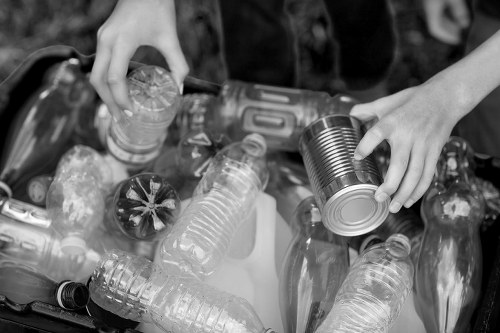
Waste segregation and hazardous materials: Items will be sorted at source into recyclable, non-recyclable and hazardous categories. Where hazardous materials are identified — for example batteries, chemicals, solvents, contaminated clinical waste or suspected asbestos-containing materials — work will stop and specialist removal or licensed disposal arranged. Under no circumstances will untrained staff attempt removal of regulated hazardous waste.
Manual handling and vehicles: Safe handling procedures and mechanical aids are used to minimise lifting injuries. Vehicle loading and unloading are controlled to prevent falls and overloading. Drivers and crew must comply with vehicle safety checks, secure loads correctly and follow safe operating procedures to protect both operatives and the public.
Emergency procedures and incident reporting: All incidents, near misses and accidents must be reported immediately. First aid arrangements, access for emergency services and an incident reporting system are maintained. Investigations will identify root causes and corrective actions to prevent recurrence. The policy reinforces a no-blame approach to reporting to encourage transparency and learning.
 Monitoring, auditing and performance: Health and safety performance is monitored through routine inspections, audits and review of incident trends. Key performance indicators for safety, training completion and equipment maintenance are tracked. Management will act on audit findings to close out identified issues and improve processes for rubbish removal and clearance work.
 Review and continual improvement: This policy is reviewed at least annually or following a significant event or change in legislation. Staff consultation and feedback shape practical improvements to safe working methods. We are committed to continual improvement and to integrating best practice into our house clearance and waste removal operations.
Commitment: By adhering to this Health and Safety Policy, House Clearance Bayswater and its workforce commit to delivering safe, responsible and professional clearance services. Everyone involved must take personal responsibility for safety, raise concerns and cooperate fully with safety management measures to protect people and property.
Scope of enforcement: This policy complements statutory obligations and industry standards for clearance and rubbish company operations. It is intended to be a working document that governs behaviour, informs training and underpins the practical steps we take to ensure safe clearances and efficient waste management.
Documentation and records: All risk assessments, training records, equipment checks, incident reports and waste transfer records will be retained for audit and continuous improvement purposes. These records support accountability and demonstrate compliance with health, safety and environmental responsibilities.